Geography and context
Las Grutas is a coastal town in the municipality of San Antonio Oeste, in northeastern Río Negro Province, on the shores of the Golfo San Matías. Its best-known distinction is water temperature: the gulf reaches 22–24°C in summer, unusually warm for Patagonia.
The warm conditions result from several combined factors: the enclosed geometry of the Golfo San Matías, tidal amplitudes of 8–10 metres that expose extensive rocky surfaces during low tide, and the intense summer sun heating those rocks. When the tide rises, cooler water flows over those sun-warmed rock surfaces and warms in the process.
The gulf runs approximately 148 km deep with a 118 km mouth between Punta Bermeja (Río Negro) and Punta Norte (Chubut). Tides are semidiurnal with ranges of 3.5 to 7.6 metres.
The town has 6,377 residents (2022 census).
What you’ll see
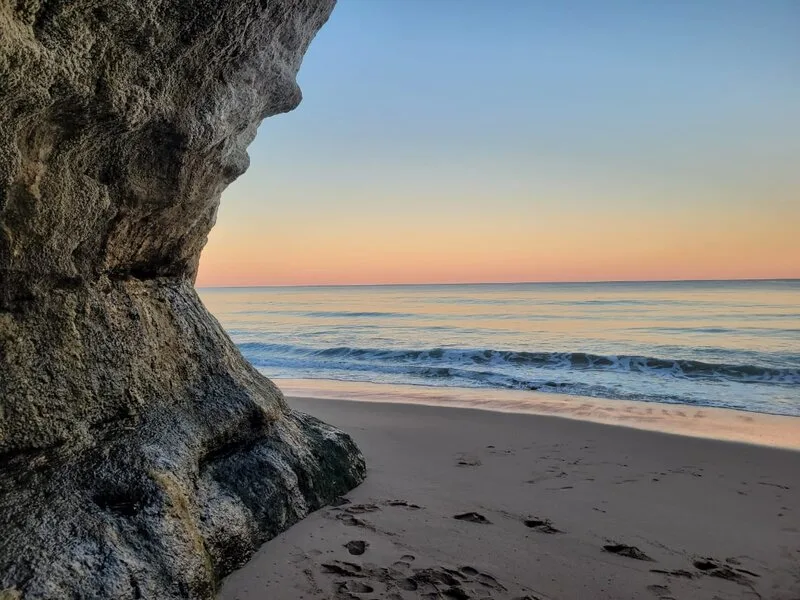
The sea caves carved into the coastal cliffs — which give the town its name — are also the main underwater landscape: sea arches, overhangs and rocky hollows form the terrain at shallow depth.
Las Grutas Underwater Park (Don Félix): five fishing vessels sunk as artificial reefs, presented by the Río Negro provincial government as the largest underwater park in South America. Don Félix (2007), Mariana Rojamar (2019), Chiarpesca 59 (2019), Polarborg I (2020) and Magdalena María II (sunk on July 7, 2023). Published depths range from 18 to 28 m; verify with the local operator before diving.
The Golfo San Matías supports considerable marine biodiversity: scallops (vieyras), mussels, sea urchins, octopuses and seahorses inhabit the rocky seabed. Surface wildlife including sea lions, Magellanic penguins, dolphins and seabirds appears regularly; these species also feature during dives at sites near their colonies.
The most accessible sites are shallow and well-suited for open-water certification dives and first sea dives. Nine official beach access points (“bajadas”) allow shore entry, making it possible to dive without a boat at the shallowest sites. The Underwater Park, by contrast, requires certification and a boat.
Warm summer water (up to 22 °C), shallow caves and shore entry also make Las Grutas a strong destination for snorkelling and recreational freediving: the caves and rock overhangs between 3 and 8 m are reachable on a single breath in calm tide conditions.
Operators
Cota Cero Buceo — local operator at the Tercera Bajada. Identified by the Río Negro government (Decree 18/2018) as Asociación Civil Cota Cero Club Náutico y Buceo, a partner in the development of the Las Grutas Underwater Park along with national, provincial and municipal authorities.
When to go
Peak season runs December to March. During those months water temperatures are at their peak, demand is highest and operators are most active. Outside summer the water cools considerably; diving is still possible but requires heavier thermal protection.
How to get there
Las Grutas is 15 km from San Antonio Oeste via Provincial Route 1. San Antonio Oeste has a bus terminal with regular services from Viedma (220 km), Bariloche (280 km) and Buenos Aires. National Route 3 — the main coastal highway — passes through San Antonio Oeste, connecting the town with Carmen de Patagones to the north and Madryn to the south.
Protected areas and regulations
The Golfo San Matías was protected from hydrocarbon exploration under provincial legislation in force since the late 1990s. In 2022, that framework was modified to allow a pipeline from the Vaca Muerta shale fields to the gulf coast, a project challenged by environmental organisations on the basis of risks to marine wildlife and nearby UNESCO-protected areas including Península Valdés.
Commercial diving operators and vessels must hold authorisation from the Argentine Naval Prefecture.
Technical tips
At Las Grutas the determining factor is not temperature but tide. With tidal ranges of 8–10 m, currents can be intense; safe diving requires synchronising entry with the slack-water window — roughly 30–40 minutes around the tidal turn, when current drops to near zero. Visibility varies dramatically: it can fall to 1–2 m during active flood or ebb and improve substantially at slack. In summer a 5–7 mm wetsuit is adequate; in winter move up to a 7 mm double or semi-dry. The sea caves and arches generate unpredictable internal currents — never enter without a local guide who knows that specific site and its tidal cycle. Adjust weighting at the start of a new season if wetsuit thickness changes.
Sources
- Río Negro government — fifth ship announcement (Underwater Park and Don Félix antecedents)
- Argentina.gob.ar — Las Grutas underwater park (project and development)
- Las Grutas Tourism — diving (municipal information)