Geography and context
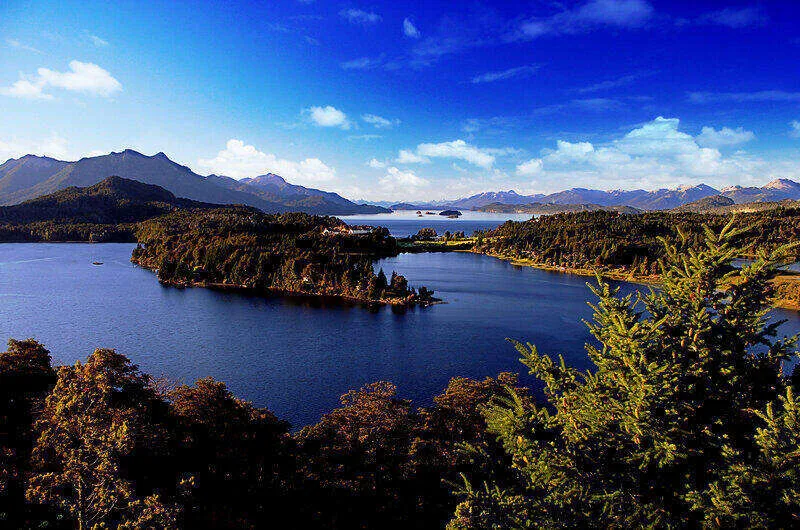
Lake Nahuel Huapi is a glacial lake straddling Río Negro (80%) and Neuquén (20%) provinces within Nahuel Huapi National Park. According to Wikipedia, it covers 557 km² and sits at 764 metres above sea level, with a maximum depth of 464 metres and a length of approximately 70 km.
The lake has eight distinct arms — Campanario, Tristeza, Blest, Machete, Rincón, Última Esperanza, Angostura and Huemul — giving it a characteristically irregular shape. Several rivers feed the lake, including the Huemul, Bonito, Correntoso and Ñirihuau; the Río Limay flows out of it and runs 500 km to the Atlantic, supplying several hydroelectric dams.
Nahuel Huapi National Park was established in 1934 under Law No. 12103 and covers more than 717,000 hectares. Its origin is notable: in 1903, surveyor Francisco Pascasio Moreno donated land near Puerto Blest under the condition it remain “preserved intact.” This gift led to the creation of the Southern National Park in 1922 — recognised as Latin America’s first national park — and the formal establishment of Nahuel Huapi National Park in 1934.
What you’ll see
Diving is explicitly listed among the permitted water activities in the park, alongside boat tours, sport fishing, windsurfing and sailing.
At 764 metres altitude, diving here requires altitude decompression planning — sea-level tables do not apply directly. The lakebed combines rocky walls, caves and submerged forests of arrayán and patagua trees in some sectors, particularly around the Blest arm and Lago Moreno.
Native aquatic species include the puyén and native criolla trout. The huillín (Lontra provocax), a critically endangered Patagonian otter, also inhabits secluded lake shores. Introduced rainbow trout, present for sport fishing, have had documented negative impacts on native fish populations according to Wikipedia.
When to go
Favourable season runs November to April, with milder weather and lower risk of adverse conditions on the water. In winter the lake is accessible but conditions are more demanding; Bariloche’s climate can be severe and boat excursions require suitable weather windows.
How to get there
San Carlos de Bariloche has an international airport with frequent connections from Buenos Aires and other cities. By road, take National Route 237 from Neuquén (430 km) or National Route 40 from the north or south. Long-distance bus service runs daily from Buenos Aires.
APN headquarters: Av. San Martín 24, Bariloche (Tel. 0294-4423111; [email protected]).
Protected areas and regulations
Diving within Nahuel Huapi National Park is regulated by the APN. Commercial operators require authorisation from the Argentine Naval Prefecture. Park entry fees are collected at control points; current rates at argentina.gob.ar/parquesnacionales/nahuelhuapi.
Sources
- argentina.gob.ar — Nahuel Huapi National Park (APN contact, visit planning)
- DPA Río Negro — Informe Final Nahuel Huapi 2006-2007 (surface water temperature annual range 5.3–19.5°C; INIBIOMA-CONICET data)
- ILEC World Lake Database — Nahuel Huapi (limnology: stratification, hypolimnion temperature 7–8°C year-round)
- Reglamento de Pesca Deportiva Patagónico — Parques Nacionales del Sur (salmonid fishing season 01/11–01/05, quotas and restrictions PN Nahuel Huapi)
Technical tips
Lake Nahuel Huapi has cold water even in summer (7–19°C depending on the season), so a 5mm wetsuit with gloves and hood is recommended year-round and mandatory from June through September. Being a National Park lake, all dives must be done with an APN-licensed operator — independent diving without a guide is not permitted. The lake sits at 764 m above sea level (the Bariloche town centre is around 770–775 m); the altitude has a minor effect on decompression tables, but local operators are aware of this and factor it into dive planning.