Geography and context
Puerto Madryn sits in northeastern Chubut Province on the western shore of Golfo Nuevo. The gulf measures roughly 65 km long by 46 km wide with a 16 km entrance flanked by Morro Nuevo and Punta Ninfas. Recent oceanographic studies place its maximum depth near 180 metres, with an average around 40 metres.
The gulf’s coastline features cliffs with protruding strata forming restingas — flat rocky platforms exposed at low tide — which are the primary habitat for most of the area’s benthic fauna.
The city is recognised as Argentina’s national diving capital. The official Chubut tourism site (chubutpatagonia.gob.ar) uses this designation directly. The waters of Golfo Nuevo are known for good visibility under optimal conditions — the clarity that underpins this reputation.
Península Valdés, declared a UNESCO World Natural Heritage Site in 1999, lies to the northeast and forms the northern boundary of the gulf.
What you’ll see
Puerto Madryn combines three types of diving experience: sea lion encounters, wreck dives and benthic reef exploration.
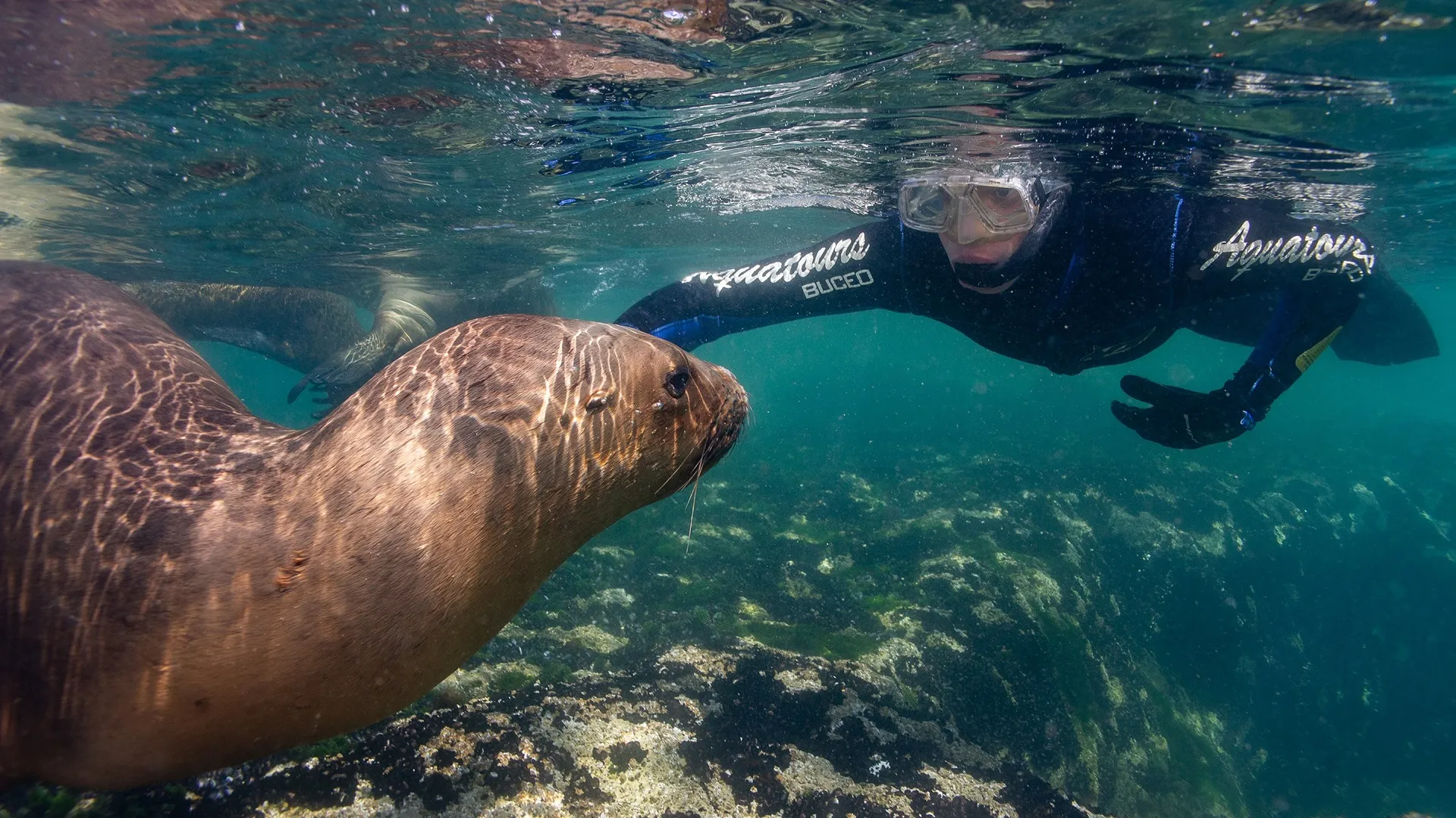
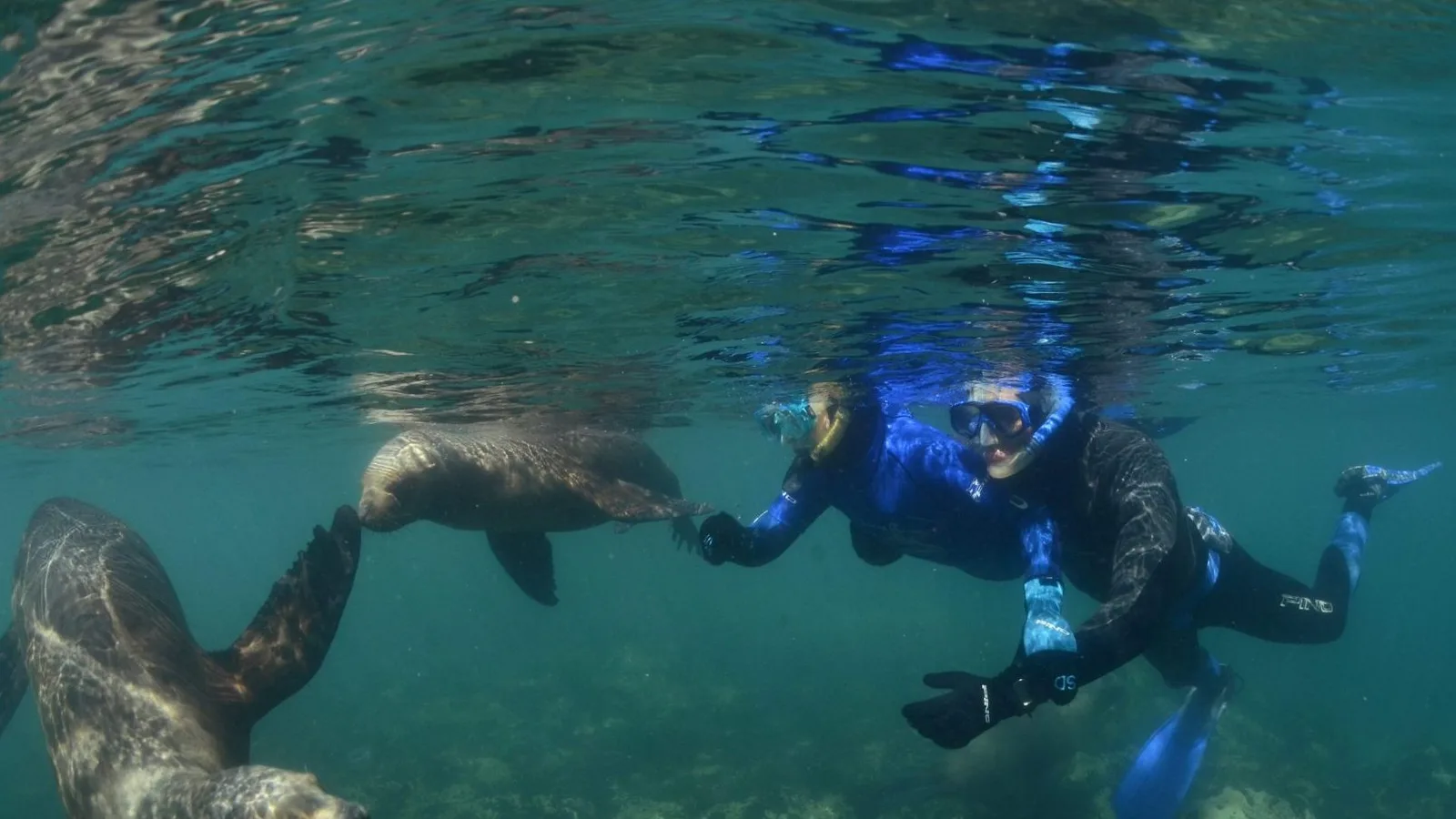
Golfo Nuevo’s restinga floors host mussels, sea urchins, starfish, anemones, sponges and a variety of Patagonian coastal fish. South American sea lions (Otaria flavescens) approach divers with notable curiosity; at Punta Loma, 14 km from town, a provincial protected area hosts a stable colony of these animals.
Wrecks are the other central attraction: several sunken vessels lie at varying depths in the gulf, documented and regularly visited by dive operators. The official Chubut tourism site confirms wreck diving as part of the local offering.
During the southern right whale breeding season (Eubalaena australis) — from May to December, with peak concentration June to October — whale calls are frequently audible during dives. The southern right whale is a national natural monument of Argentina.
When to go
Diving operates year-round according to chubutpatagonia.gob.ar. The whale season (May–December) adds a unique acoustic dimension. Summer (December–February) is peak tourist season with the comparatively warmest water. Autumn–early winter (March–June) typically offers the best visibility.
Puerto Madryn also serves as the base for excursions to Península Valdés: whale watching, orcas at Punta Norte and elephant seals at Caleta Valdés.
How to get there
Puerto Madryn has its own airport (El Tehuelche) with regular flights from Buenos Aires. By road, National Route 3 connects the city to Buenos Aires (1,380 km) and to the southern Patagonian towns. Long-distance bus service runs daily from Buenos Aires.
Dive centres are concentrated along the waterfront (Av. Julio A. Roca) and near the port.
Protected areas and regulations
Península Valdés is a UNESCO site (code 937) with six internal nature reserves. The marine zone has protection extending 3 nautical miles from the shoreline.
Entry to Península Valdés — including access to Puerto Pirámides — requires payment of an access fee at the gatehouse. Whale watching operations are regulated by Chubut Province.
Dive operators must hold Argentine Naval Prefecture authorisation. Chubutpatagonia.gob.ar notes instructors certified by PADI, PDIC or NAUI.
Tourism office contacts: Puerto Madryn Tourism, Tel. (54 280) 4453504. Península Valdés Administration: +54 9 280 447-0197.
Sources
- Marine Environmental Research, 2025 (DOI 10.1016/j.marenvres.2025.107555) (Golfo Nuevo maximum depth ~180 m)
- chubutpatagonia.gob.ar — Diving (national diving capital designation, activities, operators)
- chubutpatagonia.gob.ar — Puerto Madryn (marine fauna, Punta Loma, whale season June–December)
Technical tips
Golfo Nuevo has gentle currents at most sites near the city; more dynamic conditions occur at wrecks near the gulf’s entrance. Water is cold year-round; in winter months a drysuit or 7mm semi-dry with gloves and hood are recommended. Visibility improves significantly in the cold months — June to August — when plankton decreases. During sea lion encounters, keep arms close to your body and move slowly; they initiate contact on their own terms. Diving during whale season (June–October), it is common to hear whale song without spotting the animal: the underwater acoustics of the gulf are exceptional.