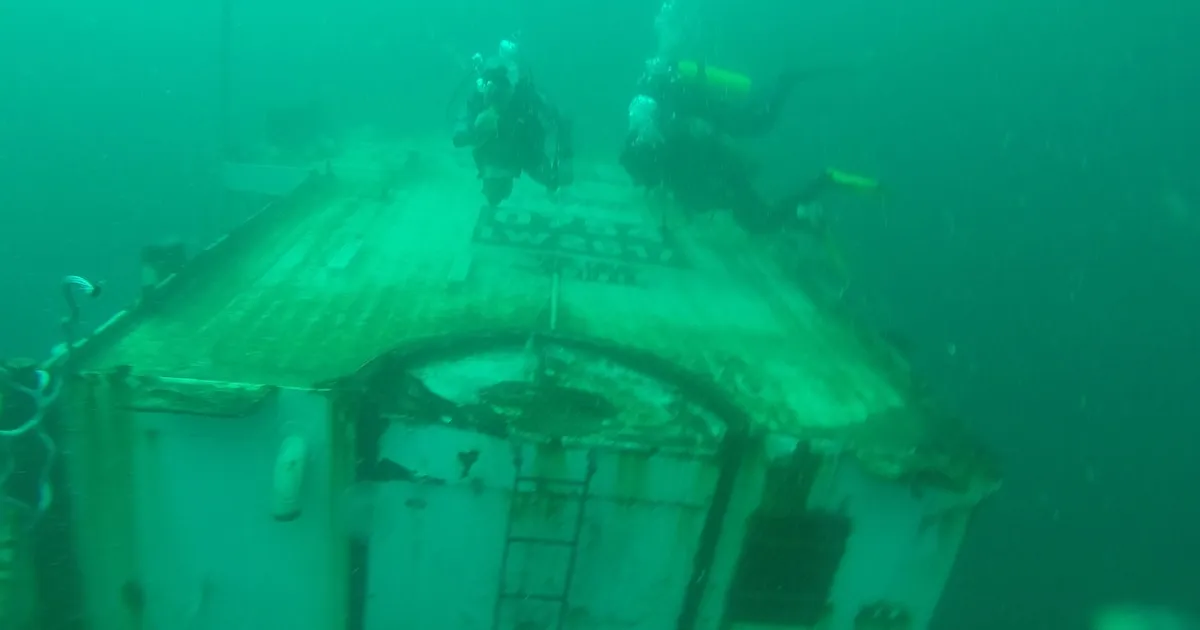
It started on June 27, 1981, when the Centro de Actividades Submarinas Escualo (CASE) sank a decommissioned vessel — the Cristo Rey, a WWII minesweeper repurposed as a fishing boat — about 5 kilometers off the Mar del Plata coast, opposite the Punta Mogotes Lighthouse. The idea was straightforward: colonizing organisms do the work on their own. Within months, hull surfaces become covered with hydroids, anemones, sponges, sea urchins, and soft coral polyps. Fish arrive next, drawn by the shelter and the food web that assembles around submerged structures.
Decades later, the project is known as the Parque Subacuático Cristo Rey (Cristo Rey Underwater Park), with four ships sunk at different points in time.
The Cristo Rey, the founding vessel, was only rediscovered in the early 2000s once GPS was available to sport divers — its exact position had been lost for decades. The Khronometer — a Russian fishing vessel of 82 meters in length, abandoned in port — was sunk on April 30, 2014 and is today the most impressive in terms of size. The Simbad, a traditional Mar del Plata fishing boat, went down on August 2, 2022. The most recent addition is the Sirius, sunk on July 21, 2024.
CASE works in coordination with the Institute for Marine and Coastal Research (IIMyC), a UNMdP-CONICET unit at the National University of Mar del Plata. Colonization studies confirm expanding biodiversity: turcos, antenitas, meros, and papamoscas are the four most abundant fish species found on the hulls; seahorses, crabs, and starfish have also been recorded near the surrounding breakwaters.
The park’s wrecks sit between 20 and 30 meters, within recreational range. CASE places the Cristo Rey at about 30 meters and the Khronometer at about 25 meters. Visibility in the Argentine Sea varies considerably — conditions are nothing like the Caribbean — but in the calmer months the experience is remarkable: exploring a dark vessel by torchlight, with currents running and organisms encrusting every centimeter of metal structure, offers something no land-based dive destination can replicate.
Local operators including Oceanica Buceo run regular trips to the park. The combination of logistical accessibility (Mar del Plata’s port is a few hours from Buenos Aires) and the variety of dive points within the park makes Cristo Rey one of the country’s most frequently visited diving destinations.
CASE’s project is also a model of circular economy applied to the sea: ships that reached the end of their useful life become habitat for hundreds of species and a tourist destination for divers across the region.
Sources
- CASE (Centro de Actividades Submarinas Escualo): Parque Submarino Cristo Rey
- Infobae (27/07/2024): The story of the abandoned ships that become reefs in Mar del Plata’s underwater park
- Oceanica Buceo: Diving in Mar del Plata
Source: Infobae