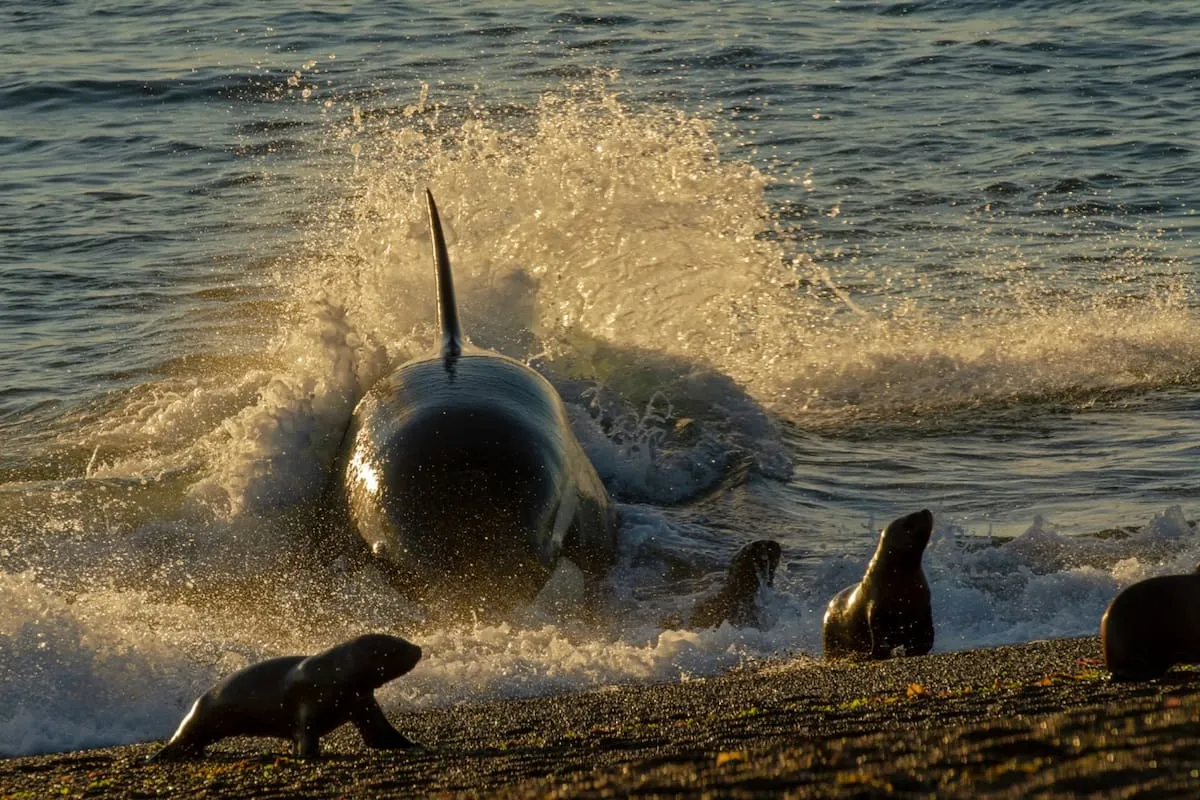
At the northeastern tip of Península Valdés, roughly 180 kilometers from Puerto Madryn, lies a 70-meter-wide beach strip that scientists call “the attack channel.” It is here that the resident orcas (Orcinus orca) of the area stage one of the most extraordinary predatory behaviors in the animal kingdom: deliberately beaching themselves on the shoreline to seize sea lion pups that venture too close to the water.
The behavior is anything but improvised. Orcas calculate tidal state, beach slope, and available water depth for the return maneuver. Researchers with the Península Valdés Orca Research Project have documented that each hunt’s success depends on three factors: high tide, pebble beaches (not fine sand), and sufficient depth for the animal to work its way back to sea without stranding permanently.
The main season at Punta Norte runs from March through May, when one-haired sea lion pups (Otaria flavescens) born in January and February begin playing near the water’s edge. Between October and November the pattern repeats roughly 50 kilometers south at Caleta Valdés, where orcas target southern elephant seal pups.
Two matriarchal families are the regular protagonists of these hunts. Researchers who have been tracking this population for decades describe them as social and familial — “very similar to humans” — with the technique passed down culturally from generation to generation within each group. This systematic behavior has not been observed anywhere else in the world.
In April 2025, photographer Maxi Jonas captured a complete hunt on video from the authorized observation platforms of the Punta Norte Natural Reserve, footage that spread across international media and renewed global attention to the phenomenon. The Península Valdés Protected Natural Area — a UNESCO World Heritage Site since 1999 — operates wildlife ranger stations that monitor each season and enable public observation from coastal viewpoints at a safe distance for both animals and visitors.
For divers based in Madryn and Puerto Pirámides, the orca season coincides with optimal underwater visibility in Golfo Nuevo. While organized dive excursions with orcas are not permitted in the protected area, many local operators combine dives in the gulf with land-based trips to Punta Norte during peak tidal windows.
The orca phenomenon at Punta Norte is a reminder that the Argentine Sea offers more than wrecks and reefs: it hosts behaviors that science continues to study and that have no equivalent anywhere else on Earth.
Sources
- La Nación (25/04/2026): Orcas at Península Valdés: the world-unique attacks on sea lions
- Diario Río Negro: Amazing video: orcas beach themselves to hunt sea lions
- Chubut Patagonia (Chubut Government): 2024 Orca Season opened at Punta Norte
Source: La Nación